
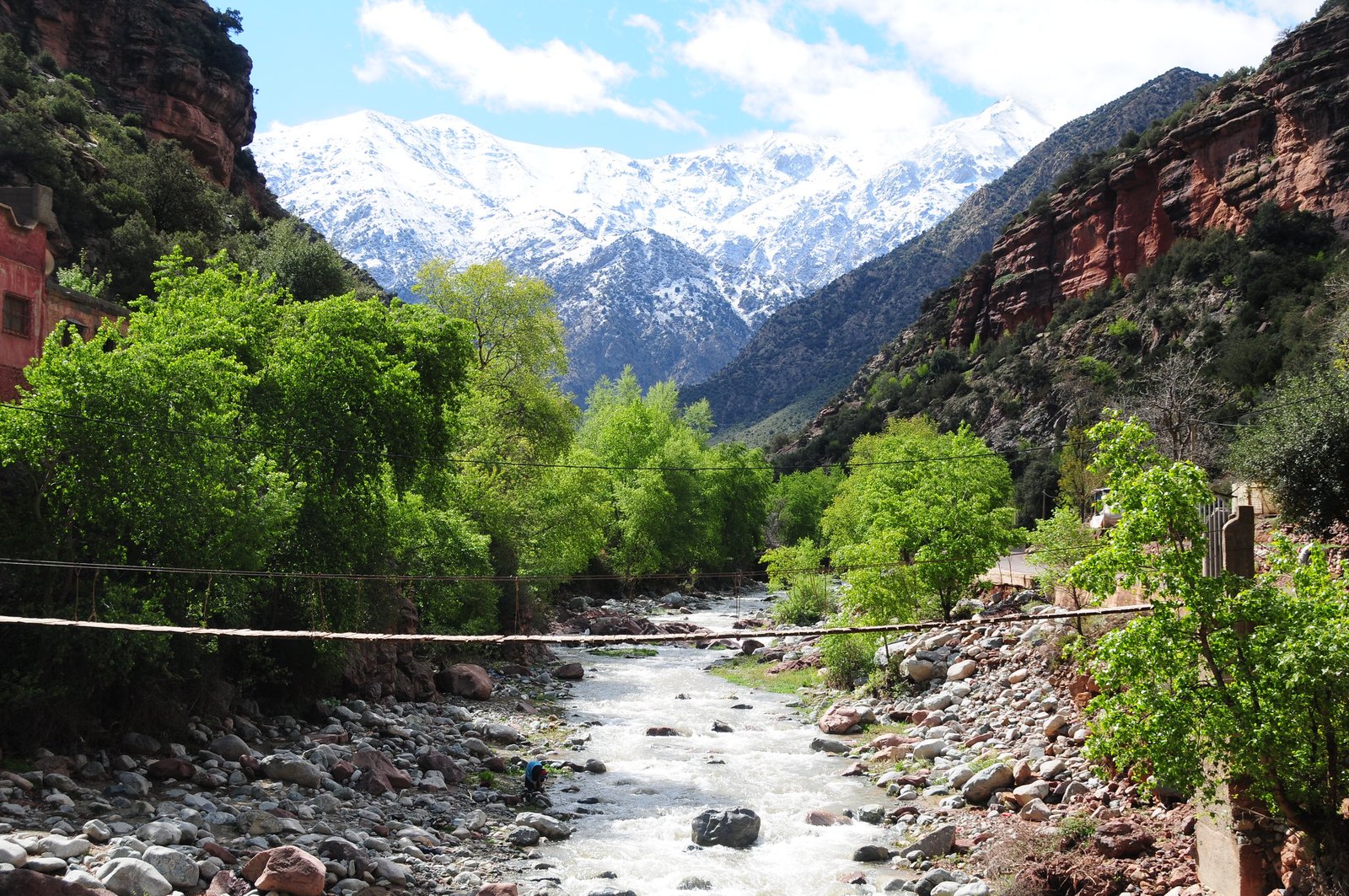
Atlas Mountains
The Atlas Mountains in Morocco form one of North Africa’s most dramatic and diverse landscapes, stretching like a great stone backbone across the country. Divided into three main ranges – the High Atlas, Middle Atlas, and Anti-Atlas – they offer everything from snow-capped peaks and lush valleys to arid plateaus and hidden oases. For travelers, they’re not just a backdrop to Marrakech or the Sahara, but a destination in their own right, rich in natural beauty, Berber culture, and outdoor adventure. Whether you’re a hiker, a photographer, or simply curious about life in remote mountain villages, the Atlas Mountains reveal a side of Morocco that feels timeless and authentic.
The High Atlas
The High Atlas, often called the “roof of North Africa,” is the most famous section and home to Jebel Toubkal, Morocco’s highest peak at 4,167 meters. Just a few hours from Marrakech, the High Atlas offers a striking contrast to the bustle of the city. Deep valleys cut through rugged slopes, traditional villages cling to hillsides, and terraced fields of barley, walnuts, and fruit trees follow the curves of the land. In winter, snow blankets the higher elevations, transforming the peaks into a dramatic white skyline and making the region a surprising destination for snow sports and winter trekking.
Toubkal National Park is the heart of trekking in the Atlas Mountains. Most journeys begin in the village of Imlil, a small but lively base at the foot of the mountains. From here, well-trodden paths lead through juniper forests, over rocky passes, and past mountain streams fed by melting snow. The ascent to Jebel Toubkal itself is demanding but accessible to fit beginners with a guide, and the panoramic views from the summit – across the High Atlas, the plains near Marrakech, and on clear days towards the Sahara – reward every step. Even for those who don’t summit, shorter hikes to nearby villages or scenic lookout points offer an immersive experience of mountain life.
The Middle Atlas
The Middle Atlas, further north, shows a gentler side of the mountain chain. Here, rolling hills, cedar forests, and lakes create an almost alpine feel, especially around towns like Ifrane and Azrou. Ifrane, sometimes nicknamed “Little Switzerland,” surprises many visitors with its European-style architecture, clean streets, and cooler climate. The surrounding cedar forests are home to Barbary macaques, a rare and endangered species that can still be seen in the wild. This region is ideal for leisurely walks, wildlife spotting, and escaping the heat of summer in Morocco’s cities and deserts.
Anti-Atlas
In contrast, the Anti-Atlas in the south feels more arid and ancient, with surreal rock formations, palm-filled valleys, and traditional mud-brick villages. Towns like Tafraoute sit amid pink granite boulders and dramatic cliffs, especially striking at sunrise and sunset when the rocks glow with soft shades of red and gold. The Anti-Atlas is less visited than the High Atlas, making it attractive to travelers seeking solitude and less developed trails. Here, the mountains blend into the gateway of the Sahara, and the interplay of desert landscapes and rocky peaks creates a unique atmosphere.
Berber Culture
One of the most rewarding aspects of visiting the Atlas Mountains is the chance to experience Berber culture. The Indigenous Amazigh (Berber) communities have lived in these mountains for centuries, maintaining a strong sense of tradition and identity. Villages are often built from local stone and earth, blending harmoniously into the landscape. Many families still farm small terraced plots, keep livestock, and rely on seasonal cycles. Travelers staying in guesthouses or village homestays can enjoy simple but generous meals, often centered around tagines, couscous, fresh bread, local honey, and mint tea.
Handicrafts
Handicrafts in the Atlas Mountains are another window into local life. Women weave colorful rugs, blankets, and textiles with geometric patterns that tell stories of their region and heritage. In some valleys, you’ll also find traditional pottery, carved wooden items, and silver jewelry. Buying directly from cooperatives or local artisans not only supports the community but also provides a meaningful, authentic souvenir. Markets on weekly souk days bring surrounding villages together, creating a vivid scene of trade, socializing, and traditional dress.
Environment & Economy
The Atlas Mountains also play a vital role in Morocco’s environment and economy. Snowfall in the High Atlas feeds rivers and reservoirs that supply water to cities and farms far beyond the mountains. Traditional irrigation systems, known as khettaras and seguias, distribute this water through valleys and fields, reflecting centuries-old knowledge of how to live with a challenging climate. As interest in eco-tourism grows, many communities are focusing on sustainable tourism projects that protect the landscape while providing income, such as guided treks, community-run lodges, and cultural experiences.
Time to visit
For travelers planning a visit, the best time to explore the Atlas Mountains depends on the region and activities. Spring and autumn are ideal for hiking in the High Atlas, with mild temperatures and clear skies. In spring, valleys burst into green, with blossoming fruit trees and wildflowers, while autumn offers crisp air and golden light. Summer can be hot in lower areas but is pleasant at higher elevations, and winter trekking is possible with proper gear and guidance. The Middle Atlas is popular in summer for its cooler climate, while the Anti-Atlas is particularly appealing in late autumn and early spring.
Reaching the Atlas Mountains is relatively straightforward. From Marrakech, day trips and multi-day tours frequently head into the High Atlas, visiting valleys like Ourika, Ouirgane, or Aït Bouguemez. Independent travelers can combine public transport, taxis, and local guides to move between towns and villages. Once you arrive in the mountains, distances on foot can be short, but the terrain makes journeys feel adventurous and immersive. Taking time to move slowly, stop in small villages, and talk with local people often becomes the most memorable part of the experience.
The Atlas Mountains in Morocco are more than just a scenic backdrop; they are a living, breathing world of culture, nature, and tradition. From the challenge of climbing Jebel Toubkal to the serenity of a cedar forest or the quiet of a remote Anti-Atlas valley, the range offers an impressive variety of experiences within one country. For anyone seeking to understand Morocco beyond its cities and deserts, spending time in the Atlas Mountains reveals the depth and diversity that have shaped the nation for centuries.
This is one of the best excursion to Atlas Mountains.